
DIVISLAB: The Infrastructure That Never Gets Called Infrastructure

The podcast version of this article is now live on Spotify and youtube. If it’s too long for a quick read, tune in instead!
Feel Free to Join us on Whatsapp , Instagram , Youtube & Spotify
Day 28/100
There is a factory in Vishakhapatnam that most people in Indian finance have never visited and a surprising number have never thought carefully about. It sits on roughly 500 acres of land, runs three shifts, employs around 700 scientists and on any given day, is synthesizing molecules that will eventually become pills inside bottles bearing logos like Pfizer, Roche and Eli Lilly. The factory does not make finished medicines. It makes the molecules that other factories turn into medicines. It is, in the most precise sense of the word, the beginning of the chain.
The company that runs it is Divi’s Laboratories. And if you think of it primarily as a pharmaceutical company, you have already made the most expensive analytical mistake you can make when studying this stock.
What It Actually Makes
Divi’s Laboratories operates across three distinct segments, but calling them segments somewhat undersells the strategic hierarchy between them.
The first is Generic APIs - the commercial manufacturing of molecules like Naproxen, Gabapentin, Levetiracetam, Dextromethorphan and Pregabalin. These are off-patent compounds. The molecule itself is not proprietary. What matters here is process chemistry, how efficiently you can produce a kilogram of that molecule at industrial scale, at the required purity, with zero regulatory flags. Divi’s sells to generic drug manufacturers globally and in several of these molecules, holds more than 50% of the global market share. That is not the kind of market share you stumble into. That is 30 years of unglamorous chemistry work, compounding silently.
The second segment is Nutraceuticals and Carotenoids - ingredients like Beta Carotene, Lutein, Astaxanthin, Vitamin D3, and Vitamin A, supplied to food, beverage, dietary supplement and feed industries. This is a niche but profitable business, sold primarily through wholly-owned subsidiaries in the US and Switzerland. It is not the growth engine. Think of it as the portfolio’s ballast.
The third segment is the one that deserves a completely different analytical framework. Custom Synthesis or what the industry increasingly calls CDMO work (Contract Development and Manufacturing). This is where Divi’s serves as the exclusive synthesis partner for innovator pharmaceutical companies developing patented, still-on-patent drugs. Gram-scale synthesis for Phase I clinical trials, kilogram-scale for Phase II and III, multi-ton commercial manufacturing for global launches. Divi’s currently works with 12 of the top 20 global innovator pharma companies in this capacity. The revenue here is roughly 45% of total revenue, with margins substantially above the generic API business.
The reason custom synthesis is structurally the most valuable business and the least understood by most equity analysts, comes down to a single word: irreplaceability. More on that shortly.
The Supply Chain No One Draws Correctly
To understand where Divi’s sits in the global pharmaceutical supply chain, you need to understand the full map…… from raw chemistry to patient.
At the very bottom of the chain are Key Starting Materials (KSMs): basic chemical building blocks, synthesized from petrochemical derivatives or basic organics. Above that sit Drug Intermediates (DIs): partially synthesized molecules, specific to a drug’s synthesis pathway. Above that is the Active Pharmaceutical Ingredient (API) itself - the molecule that actually has the therapeutic effect. Then come formulation manufacturers, who press the API into tablets or fill it into capsules or dissolve it into injectables. Finally, a distribution and logistics layer delivers the finished product to pharmacies in New Jersey or Berlin or Mumbai.
For decades, China controlled the KSM and DI layers with near-absolute dominance. Hyderabad, Ahmedabad and Vishakhapatnam controlled large portions of the API layer. The US and Europe controlled formulations and distribution. This was the equilibrium. Then COVID-19 happened, and the entire global pharma establishment woke up to what supply chain strategists had been saying for a decade: a single-source dependency on China for foundational chemical inputs is not a procurement preference. It is a geopolitical vulnerability.
China’s response, interestingly, has been to not sit still. Eli Lilly announced a separate $3 billion, decade-long investment in China in March 2026 - even as it simultaneously committed over $1 billion to India’s manufacturing capacity in October 2025. What this tells you is that the world’s largest innovators are no longer optimizing for the lowest cost single source. The’ are building redundancy. And redundancy, at the quality level required by the US FDA and the EMA, has only a small number of credible addresses globally.
Divi’s is one of them.
The PLI Scheme for Bulk Drugs, which targeted KSMs and DIs where India was dangerously import-dependent, had commissioned 38 projects covering 28 notified products as of December 2025. India’s API exports reached ₹41,493 crore in FY25 actually surpassing API imports of ₹39,215 crore for the first time. The PLI scheme avoided ₹3,591 crore in API imports as of September 2025. These are not rounding errors. They are structural shifts in the chemistry of global supply chains, and Divi’s sits at the center of gravity of that shift.
The Moat That Doesn’t Announce Itself
The easiest moat to see at Divi’s is scale. The next easiest is regulatory approvals like US FDA, EU GMP certifications that take years to build and seconds to lose. But the moat that matters most is one that doesn’t appear on any slide deck or investor presentation.
It is the switching cost embedded in custom synthesis relationships.
Here is how it works in practice. A global innovator, let’s say a large European pharmaceutical company is four years into a Phase III clinical trial for a new cardiovascular molecule. They have used Divi’s as their API synthesis partner since Phase I. Every batch of drug supplied to trial sites has been manufactured using Divi’s specific synthesis route. The regulatory dossier filed with the FDA references Divi’s facility, Divi’s process parameters and Divi’s analytical methods. That regulatory package is, in the most literal sense, built around Divi’s chemistry.
At this point, switching API suppliers is not a procurement decision. Switching means re-validating the entire synthesis, re-running comparability studies, potentially triggering a regulatory hold on the trial and adding anywhere from 18 to 36 months to the program timeline. For a drug that might peak at $2 billion in annual sales, every month of delay costs approximately $167 million in forgone revenue. The math of switching is brutal.
This is pricing power without needing to say the word “pricing power”. You do not threaten your innovator clients. You simply remain indispensable, not through contracts, but through irreversibility.
Divi’s team of 700 scientists supports this with deep process chemistry IP, not just knowing how to make the molecule, but knowing the most efficient, most scalable, most regulatorily clean way to make it. The gap between knowing a molecule’s structure and knowing how to synthesize it at 50-metric-ton scale, with 99.9% purity, with zero genotoxic impurities, is enormous. That gap is Divi’s actual product.
On Valuation and Why Most Analysts Are Looking at the Wrong Number
At a trailing PE of roughly 64-70x as of May 2026, Divi’s shows up on every screener in India as “overvalued” , Screener.in will flag it. Value Research will flag it. Your WhatsApp group’s resident “deep value” investor will send you a chart showing that Divi’s PE is at the 95th percentile of its historical range. All of this is technically correct and analytically incomplete.
The problem with using trailing PE as the primary lens for a company like Divi’s is that custom synthesis revenue is not quarterly linear. It is milestone based, project based and concentrated. A major commercial launch by a global innovator creates a step-change in Divi’s revenue that can arrive in one or two quarters and then flatten until the next launch cycle. This creates what looks like “earnings volatility” but is actually just the signature of a fundamentally different revenue model. Comparing Divi’s trailing PE to Hindustan Unilever’s trailing PE is like comparing a cricket batsman’s average over 10 tests with a single T20 score. The metric exists. It just doesn’t tell you what you think it tells you.
The metric that deserves more attention is ROCE. Divi’s currently sits at ~20.45%. Sun Pharma, which the market views as India’s premier integrated pharma company, sits at ~20.86%. Cipla and Dr. Reddy’s trail both. The fact that Divi’s - a business that operates deep in process chemistry, capital-intensive, with multi-year project cycles - delivers ROCE comparable to a diversified formulations giant with branded generics in its portfolio, is not a coincidence. It is a signal about the quality of capital deployment.
The second thing to watch is the ₹2,394 crore in capital work-in-progress as of December 2025, against which only ₹776 crore has been capitalized in the first nine months of FY26. That CWIP represents future capacity → future revenue potential, that is not yet reflected in earnings. Analyst consensus estimates ~19% EPS CAGR over the next three years. The market is not pricing in today’s earnings. It is pricing in the earnings trajectory as that capacity comes online. This is not irrational. This is how you value an infrastructure asset.
The most useful comparison here is PI Industries, Divi’s closest structural analog - a CDMO model in agrochemicals rather than pharmaceuticals. PI consistently trades at 70-80x PE. The market has learned, over years of tracking that model, that globally embedded contract manufacturers with regulated supply chain positions earn structural premiums. Divi’s is receiving the same re-rating in real time.
The other comparison worth making is Laurus Labs - which is taking the opposite strategic path from Divi’s. Laurus is moving up the value chain, toward finished formulations, toward branded generics, toward retail pharmacy exposure. Divi’s is deliberately staying deep in process chemistry, refusing the margin diluting temptation of formulations. Neither strategy is wrong. They are different bets on where the structural advantage lies. The market currently believes Divi’s bet is the right one for this decade, and the Q2FY26 numbers net profit of ₹696 crore, up 34.36% YoY, total income of ₹2,806 crore, up 16.58% suggest the earnings recovery is not cosmetic.
Why the Stock Is Near All-Time Highs When the Broader Market Is Not
This question deserves a direct answer because the surface-level answer “it’s a good business” misses the mechanics.
The first driver is sector rotation. When macro uncertainty rises, global exporters with hard-currency revenue and secular demand tailwinds become relative safe havens. Healthcare spending does not correlate tightly with economic cycles. People do not stop taking their blood pressure medication when the Nifty corrects.
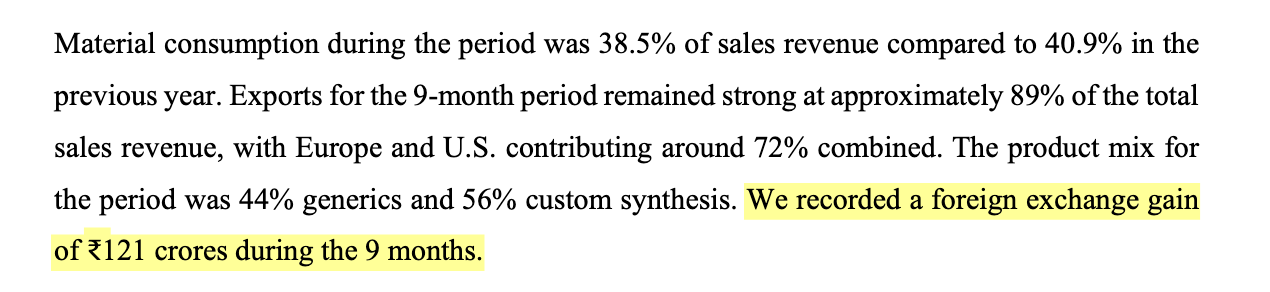
The second driver is rupee depreciation. Divi’s earns predominantly in USD and EUR, consolidates in INR. Every 1% depreciation in the rupee is a direct margin tailwind. In a macro environment where the rupee has faced pressure, Divi’s 9 month consolidated forex gain stood at ₹121 crore through December 2025. That is not trivial for a business operating at Divi’s margin levels.
The third driver is the structural re-rating from the India-US trade framework. The February 2026 interim agreement explicitly included generic pharmaceuticals in the category of Indian goods eligible for tariff removal by the US. For a company with heavy US exposure in both generic APIs and custom synthesis, this is not background noise. It is a fundamental improvement in the economic terms of the business.
The fourth driver is the India-UK CETA signed in July 2025, which opened zero-duty access for 56 pharmaceutical tariff lines. The fifth is the PLI-driven improvement in India’s API independence from China. All of these together create a macro environment where Divi’s structural advantages compound faster than they would in a normal cycle.
And the fifth driver, the one most analysts underweight is the GLP-1 wave. The global explosion in GLP-1 drugs (semaglutide, tirzepatide and their successors) has created a supply bottleneck not at the formulation level, but at the API synthesis level. Divi’s has positioned itself within this supply chain, though the exact scope of its exposure remains undisclosed. What is not undisclosed is that every serious innovator building out GLP-1 API supply is looking at a very short list of credible global synthesis partners. Being on that list is worth something that cannot be easily modeled in a DCF.
The Competitive Landscape as Diagnostic Tool
Looking at Divi’s competitors reveals something more interesting than a ranking table.
Sun Pharma, with a market cap of ₹4,43,373 crore and ROCE of ~20.86%, trades at roughly 40x PE which is less than 60% of Divi’s multiple. Sun is a diversified integrated pharma company with global branded generics, a domestic formulations business and specialty dermatology in the US. It has more revenue diversification, more business lines and lower revenue concentration. Yet it trades at a significant PE discount to Divi’s. The market is telling you something here and it is this: Divi’s is not being priced as a pharma company. It is being priced as a global supply chain infrastructure asset. The premium reflects not just today’s earnings, but the embedded optionality of being irreplaceable in a $1.41 trillion global biopharma market growing at 8.6% CAGR through 2034.
The infrastructure analogy is not accidental. Think about how the market prices a major Indian port operator or an airport concessionaire. The asset itself is the moat. The traffic flows through it because there is no viable alternative for that geography. Divi’s custom synthesis business works identically. The traffic which is the global pharmaceutical supply flows through Vishakhapatnam because there is no viable alternative for that molecule, at that scale, with that regulatory history. Price-to-Book at ~10.2x looks extreme until you stop thinking about it as a manufacturing company and start thinking about it as an infrastructure company with a 30-year head start.
India’s Pharmaceutical Sovereignty and Why It Matters
India’s pharma sector reached ₹4.72 lakh crore in annual turnover in FY25, with exports growing at 7% CAGR over the last decade. The country is the third-largest pharmaceutical producer by volume globally, and the largest supplier of generic medicines to the world. But for most of its modern history, India’s pharma prowess was downstream - formulations, generic pills - while the upstream chemistry sat in China.
That is changing. India’s API exports surpassed imports for the first time in FY25. The McKinsey projection of India’s CDMO market reaching USD 20 billion by 2030 reflects a structural shift that is already partially priced into stocks like Divi’s, but is perhaps not fully appreciated in its geopolitical dimension.
When India becomes a net API exporter, this is not just GDP arithmetic. It is strategic sovereignty. It means that the next time a global health emergency disrupts Chinese manufacturing, India is not a victim of the supply chain. India is the alternative supply chain. That is a completely different geopolitical position and the companies that built the chemistry infrastructure to make it possible - quietly, over three decades of unglamorous process work are not going to give that position up easily.
Divi’s promoter holding stands at 51.88% as of March 2026, unchanged. The founding family has never reduced. In Indian equity markets, where promoter pledge and dilution are genuine risks at many companies, this kind of sustained high conviction from the people who know the business best is worth noting.
The Risks (Written Honestly, Not as a Legal Disclaimer)
The biggest single risk to Divi’s is an FDA import alert. This is not hypothetical - it happened in 2019-2020 and erased roughly 40% of the market cap in a short period. The FDA’s regulatory scrutiny of Indian API manufacturers is structural, not cyclical. A single data integrity issue or contamination incident at either of Divi’s two manufacturing units can trigger a warning letter that effectively shuts off US market access. For a company with heavy US exposure, the asymmetry of this risk is severe.
The second risk is earnings concentration. Twelve innovator relationships drive the bulk of custom synthesis revenue. These are large, sticky, multi-year relationships but they are not evenly distributed. If one or two key relationships face commercial setbacks (trial failure, withdrawal, patent expiry, or competitor API approval), the revenue impact is visible and immediate.
The third risk is the capex cycle. The ₹2,394 crore in CWIP as of December 2025 needs to generate revenue by FY27-28. CWIP is, by definition, not yet earning. If capacity additions are delayed, due to regulatory validation timelines, project specific commissioning issues, or global demand shifts - the market will re-price the growth trajectory quickly.
The fourth risk is GLP-1 exposure opacity. The market has partially priced in Divi’s participation in the GLP-1 supply chain, but the actual scope and duration of these relationships is not publicly quantified. If Eli Lilly’s manufacturing strategy shifts - the company announced a separate $3 billion China investment as recently as March 2026 or if a different API synthesis partner is favored for next-generation GLP-1 molecules, Divi’s positioning in this wave could be more limited than currently assumed.
The fifth risk is China’s response. Chinese API manufacturers are investing heavily in regulatory compliance - EU GMP certifications, US FDA approvals. The cost-competitiveness advantage that Indian API manufacturers hold over their Chinese peers has been narrowing. It will not disappear. But the gap that currently protects Divi’s pricing in generic APIs is not permanent.
The Question That Doesn’t Have a PE Answer
At some point, certain businesses become so embedded in the fabric of global supply chains that valuing them using conventional financial ratios feels like trying to price a bridge using the cost of steel. The bridge’s value is not in its construction materials. It is in the traffic it carries, the alternatives that don’t exist, the city that would grind to a halt without it.
Divi’s Laboratories, after 30 years of deliberately unglamorous chemistry work, has become something close to that kind of asset. Not for India but for the world. Twelve of the top twenty global innovator pharma companies have decided, after years of due diligence and regulatory scrutiny, that they trust this company in Vishakhapatnam with the most critical input in their drug development pipeline. They have built their clinical trial timelines, their regulatory dossiers, their commercial launch schedules around its processes. They are not leaving because there is a cheaper option. They are not leaving because valuations look stretched. They stay because the cost of leaving is higher than the cost of paying whatever Divi’s charges.
That’s the thing about moats built from chemistry and trust and regulatory history. They don’t show up in a screener. But they compound, quietly, in Vishakhapatnam, three shifts a day.
Found this useful? Follow for Equity Decoded by Spirit for more such deep dives.
👉 Join Community Channel for FREE on whatsapp: https://whatsapp.com/channel/0029VbCUIyF3AzNIZAA6GX0K
If you enjoyed this piece and want more thoughts on economy, equity markets, finance, and how human behavior actually drives markets, feel free to follow and subscribe to my newsletter. I’d love to have you along for the journey.
Special thanks to Parth Verma SOIC Finance Zerodha Aftermarket Report by Zerodha
Some More Articles For You To Read
The Crowd That Buys High and Sells Low: Inside India’s ₹1.8 Lakh Crore Behavioral Trap
FII vs DII: The Hidden Chess Match That Controls Your Portfolio
The Phoenix Protocol: Why America’s “Failure” in Iran is its Greatest Victory
The Sanction That Became a Stimulus: How Washington Accidentally Built China’s Semiconductor Empire
The Quiet Outperformer: Why CCL Products Is Near Its 52-Week High While the Market Burns
India’s Geospatial Sector, Space Ambitions and the Quiet Reordering of Power
India’s Oil Trap: The Hormuz Blockade Is a Far Bigger Crisis Than Anyone Is Admitting
India’s Solar Boom Has a Glut Problem Nobody Wants to Talk About
The Wire Behind Everything: A Deep Dive Into India’s Cable Sector
The Race to Own India’s Digital Spine: A Deep Dive into the Data Centre Sector
The Lemon Tree: India’s Most Interesting Hospitality Bet Isn’t What You Think
The Hidden Gear: How Operating Leverage Compounds Wealth Before the Market Wakes Up
Tags: CDMO, PLI Scheme, India PLI, Pharma Investing , #Investing , #Finance , #Valuation , India , Mutual Fund , #AI , #Multibagger 100DaysWithTVS
This article is for educational and informational purposes only. Nothing written here constitutes investment advice. Please consult a SEBI-registered investment advisor before making any investment decisions.